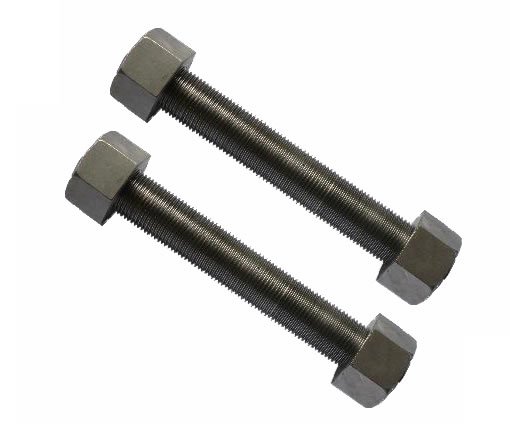
High Pressure Bolting – Studs
May 25, 2010 by Sigma Fasteners · Leave a Comment
REFERENCE
Stud bolts for pressure-temperature applications conform to the requirements of ANSI/ASME B16.5, Steel Pipe Flanges and Flanged Fittings.
LENGTH-FIRST TO FIRST
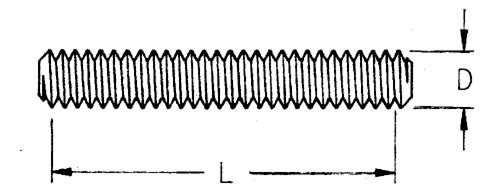
The length of stud bolt, measured parallel to the axis, is the distance from first thread to first thread. First thread is defined as the intersection of the major diameter of the thread with the base of the point. Please see the drawing above-this is confusing to most users!! Stud bolts are normally available in 1/4 inch length increments. Length tolerances, all stud bolt sizes, shall be as tabulated below:
Length, in. Length Tolerance, in.
to 12 +/-0.062
over 12 to 18 +/-0.125
over 18 +/-0.250
POINTS
Points shall be flat and chamfered, or sheared at option of the manufacturer. When points are flat and chamfered, the diameter of the flat shall not exceed the minor diameter of the thread, and shall be not less than one or more than two complete threads as measured from the extreme end parallel to the axis.
THREADS
Threads shall be Unified inch coarse thread series (UNC), Class 2A, for all stud bolt sizes 1 in. and smaller, and Unified inch 8 thread series (8 UN), Class 2A, for all stud bolts larger than 1 in., in accordance with ANSI/ASME B1.1. Acceptability of screw threads shall be determined based on ANSI/ASME B1.3.
MATERIAL
Chemical and mechanical requirements shall be specified by the purchaser and shall be in accordance with applicable ASME, ASTM, and ANSI codes and specifications current at the time of ordering.
DESIGNATION
It is recommended that stud bolts be designated in the following sequence: product name, nominal size, threads per inch, length, material, and protective finish, if required.
Example: ANSI/ASME B16.5 stud bolt,
5/8-11 x 3-1/2, ASTM A193, Grade B7, Zinc & Clear Chromate Plated
Bolting And Ring Gasket Requirements
March 19, 2010 by Sigma Fasteners · Leave a Comment
ASME/ANSI B16.5 – 1996 – Pipe Flanges and Flanged Fittings
The ASME B16.5 – 1996 Pipe Flanges and Flange Fittings, flange bolt and gasket standard covers pressure-temperature ratings, materials, dimensions, tolerances, marking, testing, and methods of designating openings for pipe flanges and flanged fittings.
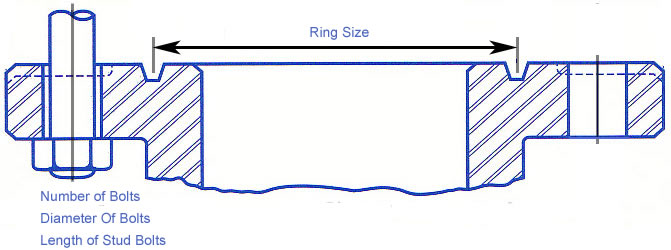
The standard includes flanges with rating class designations 150, 300, 400, 600, 900, 1500, and 2500 in sizes NPS 1/2 through NPS 24, with requirements given in both metric and U.S units. The Standard is limited to flanges and flanged fittings made from cast or forged materials, and blind flanges and certain reducing flanges made from cast, forged, or plate materials. Included in this Standard are requirements and recommendations regarding flange bolting, flange gaskets, and flange joints. The standard covers the required number of bolts, diameter of the stud bolts, length of stud bolts and ring size in R, 1RF, RTJ, and RX gaskets.
Tap End Stud
February 19, 2010 by Sigma Fasteners · Leave a Comment
Sigma Fasteners manufactures Tap End Stud bolts to your print, Tap End Stud Bolt Standard or AWHEM Standard in all ASTM grades.
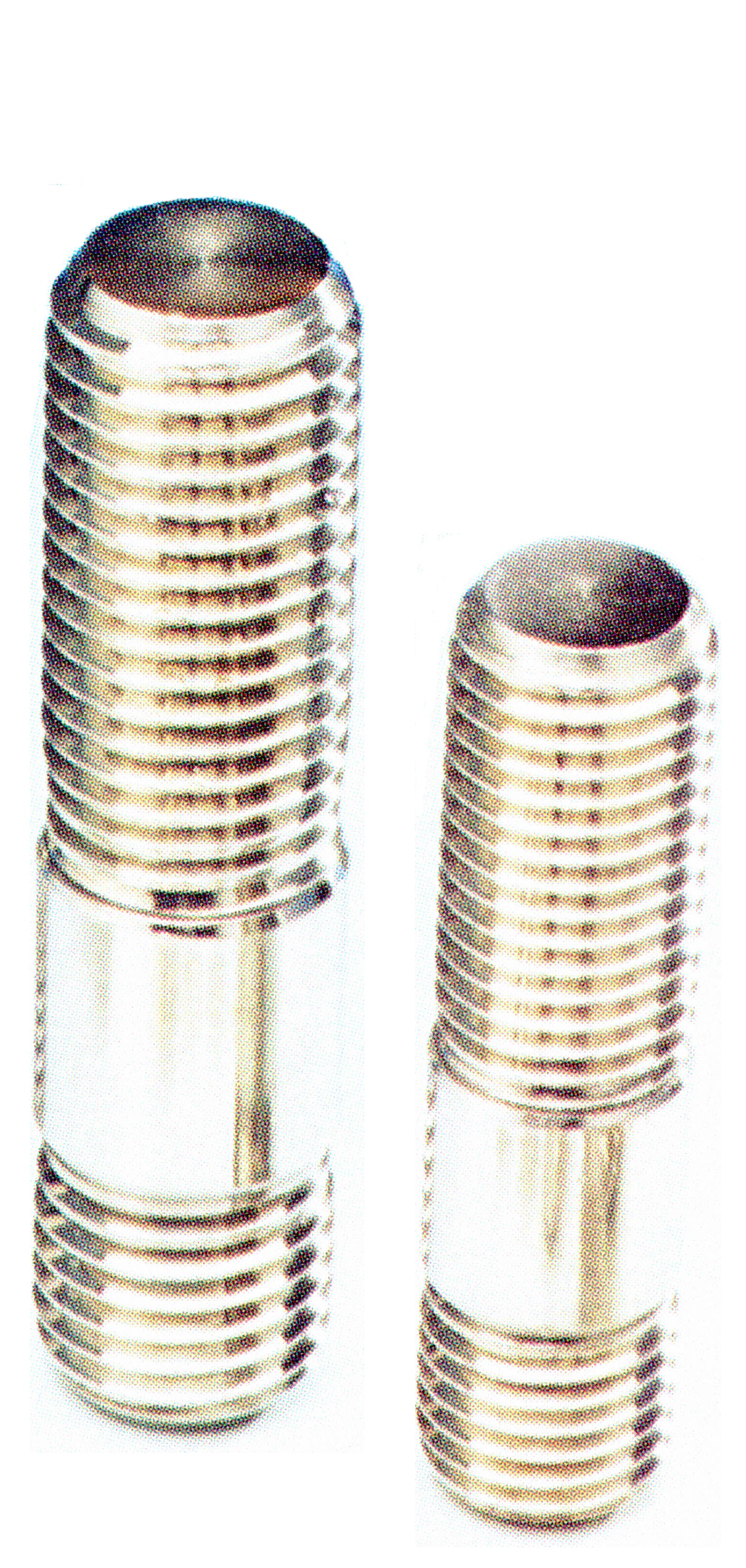
Tap end studs have a short thread length on the tap-end side typically threaded tor Class UN-3A fit. This side is screwed into a tapped hole. The nut end of the stud is threaded with a Class UN-2A fit. Length of the stud is measured form end to end. The tap end has a chamfered point, but the nut end may have either a 30° or 45° chamfered end or round raduised end, at the customers option.The tap end can be measured from the end to last scratch, end of the chamfer to the last full thread or any combination of last scratch, last full thread, end or end of chamfer.
Tap-end studs with multiple finishes:
Unfinished or black, zinc plated, Xylan coated, PTFE coated. Moly coated, Cad Plated for export.
Sigma can lower your cost for tap end studs with contract pricing and managed inventory.
Catalog: Tap End Stud
Double End Studs
February 11, 2010 by Sigma Fasteners · Leave a Comment
Double End Studs – Double ended studs
At Sigma Fasteners we provide mission critical bolting products for the nations leading manufacturers of pressure control equipment for controlling pressures during drilling and oil production.
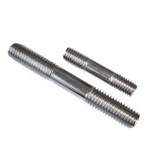
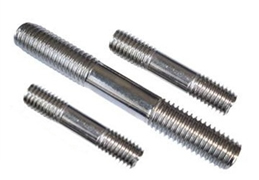
Double-end studs used by many of these manufacturers have equal-length threads on each end to accommodate a nut and are threaded to a Class 2A fit. Length of stud is measured overall. Both ends have chamfered points, but round points may be furnished on either or both ends at the manufacturer’s option, This style is furnished in the same four types listed for tap-end studs. Double-end studs are used for flange bolting or other applications where torching from both ends is necessary or desirable.
Most steel grades not heat treated or quenched and tempered can be furnished on special order for production quantities. Only the Type 2 continuous thread studs made to specification ASTM A193 grade B7 are stocked in a full range of sizes.
Stud Bolts
February 5, 2010 by Sigma Fasteners · Leave a Comment
Stud Bolts
Stud bolts are available in ASTM Grades B7, L7, B16, B16M, L7M, B8, 660 and B8M; they are also available exotic metals such as Monel, Titanium, Inconel, Alloy 20, and Hastelloy, 17-4PH. These studs are also available with industrial coatings such as SermaGard, Xylan, Teflon, Fluoropolymers and other coatings.
Stud Bolts for Pressure-Temperature Piping
- Continuous Thread Studs (Fully Threaded Studs)
Stud bolts are threaded end to end and are often used for flange bolting with two nuts on either end.
There are two types of these studs.
- Type one – usually for general purpose; the length of stud is measured from end to end. Threads are UNRC-2A.
- Type two – studs for high temperature pressure piping. These studs are made to dimensional standard requirements of ANSI B16.5 the length of this stud is measured from first thread to first thread, exclusive of points. Threads are UNRC-2A for sizes 1 inch and under and 8 UNR-2A for sizes over 1 inch. The length of stud bolt, measured parallel to the axis, is the distance from first thread to first thread. First thread is defined as the intersection of the major diameter of the thread with the base of the point.