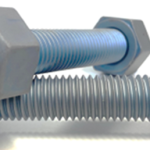

Zinc Phosphate Coating
July 20, 2010 by Sigma Fasteners · Leave a Comment
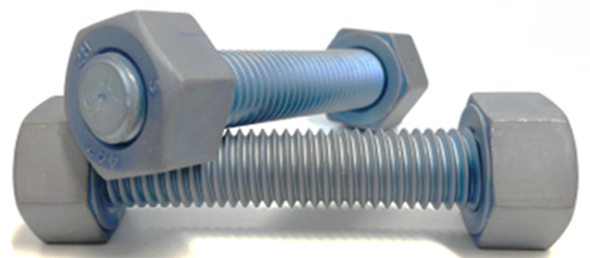
Zinc Phosphate coating is a crystalline conversion coating that is formed on a metal substrate. The phosphate process relies on the chemical reaction between the metal and the mildly acidic phosphate liquid to form insoluble crystalline phosphates on the surface of the part.
The phosphate coating is used as a pretreatment prior to painting, increasing corrosion protection, and providing for a better adhesion of the coating system.
When phos is used alone or in combination with oil (phos and oil) it lowers friction characteristics of sliding components or threaded parts. While typically called phos coating, phosphate alone has poor rust inhibiting characteristics and must be used in combination with oil or a top coat for corrosion protection. Zinc Phosphate can be applied to Ferric metals, but has no effect on Stainless Steel.
Phosphate Coating Characteristics
Color: dark gray / black
Typical Use: Anti –Galling/Basecoat
Top Coat: Oil or Paint
SermaGard Coated Bolts
May 17, 2010 by Sigma Fasteners · Leave a Comment
ASTM F1428 – 92(2005) – Standard Specification for Aluminum Particle-Filled Basecoat/Organic or Inorganic Topcoat, Corrosion Protective Coatings for Fasteners
The ASTM F1428 specification as applied by Sigma Fasteners covers the corrosion-resistant coating system consisting of an inorganic aluminum particle-filled basecoat (SermaGard 1105) and an organic topcoat (SermaGard 1280 or Xylan 1014). The SermaGard basecoat is a water soluble slurry containing aluminum particles, a ceramic oxide pigment dispersed in a liquid binder of chromate/phosphate compounds. The organic topcoat consist of polymer and / or Fluoropolymer resins and pigments. At Sigma Fasteners these coatings are applied by conventional spray methods. The maximum service temperature of the coating system is 450° F (230° C). The coating system has a low susceptibility to inducing hydrogen embrittlement in steel parts of tensile strengths ≥ than 1000 MPa (≈RC31)
This coating system specification can be applied to alloy steels (ASTM A193 Grade B7), ferritic and austenitic stainless steels (ASTM A193 GradeB8 and Grade B8M).
This coating system is in use in major offshore drilling, chemical and petrochemical facilities in the United States and worldwide.
SermaGard 1105 (ASTM F1428)
Sigma Fasteners is a licensed applicator for SermaGard products. 1105 is a ceramic-metallic sprayed
basecoat that at 1 mil of thickness or more affords 3000-4000 hours of ASTM B117 salt spray resistance,
with an appropriate topcoat. It can be used at high temperatures. It is extremely effective in salt
atmospheres. The SermaGard 1105 process involves curing at high temperatures (Minimum of 750 deg.
F) and subsequent burnishing with appropriate blast media to achieve conductivity. SermaGard 1105
contains aluminum flake.
SermaGard 1280
SermaGard 1280 is a fluorocarbon topcoat, which when applied to SermaGard 1105 basecoat gives
superior corrosion resistance and UV protection.
Coated Bolts
March 29, 2010 by Sigma Fasteners · Leave a Comment
Xylan Coated Bolts
Improve Make up and break out torque of bolts. Xylan is a fluoropolymer topcoat manufactured by Whitford Corporation, which in the 1014 and 1070 coatings afford high lubricity (co-efficient of friction as low as .02), and corrosion resistance of approximately 1000 hours(ASTM B117) when applied over phosphate, and up to 2000 hours when applied over electroplating. These are solvent based thin film topcoats. These Xylan products have a maximum temperature ranging up to 500 deg. F. Xylan 1000 and 1400 series may also be applied over other basecoats, for added corrosion protection. The 1400 series coatings by Whitford (typically 1424), are low voc coatings. They have a coefficient of friction of .05 to .10, and a maximum constant operating temperature of 400 deg. F. The corrosion resistance of the 1400 series is approximately 1500 hours, when applied over a suitable basecoat such as zinc electroplating.
Sermagard Coated Bolts
Sigma Fasteners is a licensed applicator for Sermagard products. 1105 is a ceramic-metallic sprayed basecoat that at 1 mil of thickness or more affords 3000-4000 hours of ASTM B117 salt spray resistance, with an appropriate topcoat. It can be used at high temperatures. It is extremely effective in salt atmospheres. The Sermagard 1105 process involves curing at high temperatures (Minimum of 750 deg. (F) and subsequent burnishing with appropriate blast media to achieve conductivity. Sermagard 1105 contains aluminum flake and Chromate. Sermagard 1280 is a fluorocarbon topcoat, which when applied to Sermagard 1105 basecoat gives superior corrosion resistance and UV protection.
Moly Coated Bolts
Molybdenum disulfide coated bolts are commonly used to improve the performance in extremes of load carrying capacity, operating temperature and coefficient of friction. This coating provides effective lubrication in a wide range of loads, in many cases exceeding 250,000 psi. Moly coatings lubricate sacrificially by transferring lubricant between the two mating surfaces, which helps to reduce both wear and the coefficient of friction. Moly coatings are a combination of molybdenum disulfide lubricant and high performance resins. The coating is thermally cured to bond thoroughly with the base metal of the coated part. Moly coated bolts can solve problems associated with corrosion, chemical exposure, and abrasion. offer excellent corrosion and chemical resistance and a barrier protection better than phosphate. With Moly’s exceptional barrier protection, it is appropriate for more severe environments and is often used in chemical processing and oil field equipment.
Teflon Coated Bolts
Over seventy years ago a DuPont scientist, discovered polytetrafluoroethylene (PTFE) — a fluoropolymer that is corrosive chemical and heat resistance, and the world’s most slippery surface. Teflon Coated Bolts have a Low Coefficient of Friction – The coefficient of friction of Teflon is generally in the range of 0.05 to 0.20, depending on the load, sliding speed, and particular Teflon coating used. Teflon Coated Bolts are Nonwetting – Since surfaces coated with Teflon are both oleophobic and hydrophobic, they are not readily wetted. Cleanup is easier and more thorough—in many cases, surfaces are self-cleaning. Teflon Coated Bolts are Heat Resistance – Teflon industrial coatings can operate continuously at temperatures up to 260°C/500°F. Teflon Coated Bolts have Cryogenic Stability – Many Teflon industrial coatings withstand severe temperature extremes without loss of physical properties. Teflon industrial coatings may used at temperatures as low as -270°C/-454°F. Teflon Coated Bolts are Chemical Resistance – Teflon is normally unaffected by chemical environments. The only chemicals known to affect all Teflon industrial coatings are molten alkali metals and highly reactive fluorinating agents.
Flouropolymer Coated Bolt Torque
March 19, 2010 by Sigma Fasteners · Leave a Comment
API 6A is an International Standard which specifies requirements and gives recommendations for the performance, dimensional and functional interchangeability, design, materials, testing, inspection, welding, marking, handling, storing, shipment, purchasing, repair and re-manufacture of wellhead and well tree equipment for use in the petroleum and natural gas industries.
Covering bolts on Wellhead Equipment, Valves and chokes, and loose flanged connectors.
|
TORQUE FOR FLANGE BOLTING (B7/L7 STUDS)* |
|||||
|
ANSI / API 6A / ISO 10423:2003 Feb. 1, 2005 |
|||||
| ASTM A193 Grade B7 Tensile and Yield Strength 2 1/2″ and under – tensile 125 ksi; yield strength 105 ksi Over 2 1/2″ to 4″ – tensile 115 ksi; yield 95 ksi Over 4″ to 7″ – tensile 100; yield 75 ksi ASTM A320 L7 Tensile and Yield Strength |
|||||
|
Source: API 6-A, 19th Appendix D, Table D1 & |
|||||
| Stud Diameter | Tension | PTFE Coated Bolt coefficient of Friction | Plain Bolt coefficient of Friction | ||
| Size | Ibf | Torque | Torque | Torque | Torque |
| Inch | Nm | Ft. lbs | Nm | Ft. lbs | |
| f=0.07 | f=0.07 | f=0.13 | f=0.13 | ||
| 1/2″ | 7450 | 48 | 35 | 80 | 59 |
| 5/8″ | 11865 | 92 | 68 | 155 | 115 |
| 3/4″ | 17559 | 160 | 118 | 270 | 200 |
| 7/8″ | 24241 | 253 | 188 | 429 | 319 |
| 1″ | 31802 | 376 | 279 | 639 | 474 |
| 1 1/8″ | 41499 | 540 | 401 | 925 | 686 |
| 1 1/4″ | 52484 | 745 | 553 | 1285 | 953 |
| 1 3/8″ | 64759 | 996 | 739 | 1727 | 1281 |
| 1 1/2″ | 78322 | 1297 | 962 | 2261 | 1677 |
| 1 5/8″ | 93173 | 1653 | 1226 | 2894 | 2146 |
| 1 3/4″ | 109313 | 2069 | 1534 | 3636 | 2696 |
| 1 7/8″ | 126741 | 2549 | 1890 | 4493 | 3332 |
| 2″ | 145458 | 3097 | 2297 | 5476 | 4061 |
| 2 1/4″ | 186758 | 4418 | 3276 | 7851 | 5822 |
| 2 1/2″ | 233212 | 6068 | 4500 | 10828 | 8030 |
| 2 5/8″ | 233765 | 6394 | 4716 | 11429 | 8430 |
| 2 3/4″ | 257694 | 7354 | 5424 | 13168 | 9712 |
| 3″ | 309050 | 9555 | 7047 | 17156 | 12654 |
| 3 1/4″ | 365070 | 12154 | 8965 | 21878 | 16136 |
| 3 3/4″ | 491099 | 18685 | 13782 | 33766 | 24905 |
| 3 7/8″ | 525521 | 20620 | 15208 | 37293 | 27506 |
| 4″ | 561108 | 22683 | 16730 | 41057 | 30282 |
*This chart is for general practice purposes only and should not be in the engineering or design of any products. The most current edition of the API specification may be obtained on the API Standards website to make sure you have the most current edition of API 6A. For most the accurate references in critical situations torque values should be replaced with field measured tension values. Accurate stud tension is difficult to attain using torque, because friction has a significant effect on the torque–tension relationship. Any thread damage (however minor), additional lubrication, or standard deviations within the range can change friction and thereby the expected outcome.
Xylan Coated Bolts
February 19, 2010 by Sigma Fasteners · Leave a Comment
Xylan Coated Stud Bolts
Xylan 1010, 1070, 1014, 1052 and now 1424 have been used as bolt coatings for almost a quarter century now. Most major Oil and Chemical Companies recognizing that maintenance is a huge issue have made coated bolt specifications for bolted high pressure flange connections. The various properties on the Xylan give excellent make up and brake out torque and reduce the need for high risk cutting torches or high cost bolt cutting when maintenance is required.
Xylan 1014 in bolt coatings used for its good lubricity, chemical and abrasion resistance.
Xylan 1052 for coated bolts used for its excellent lubricity.
Xylan 1070 and 1010 where the pioneers in the field – used for the lubricity and chemical inertness.
With VOCs an ever present issue these days Whitford has made a low VOC version 1424 which Sigma applies to achieve the results need in a coated bolt connection and to stay complaint in a green economy.
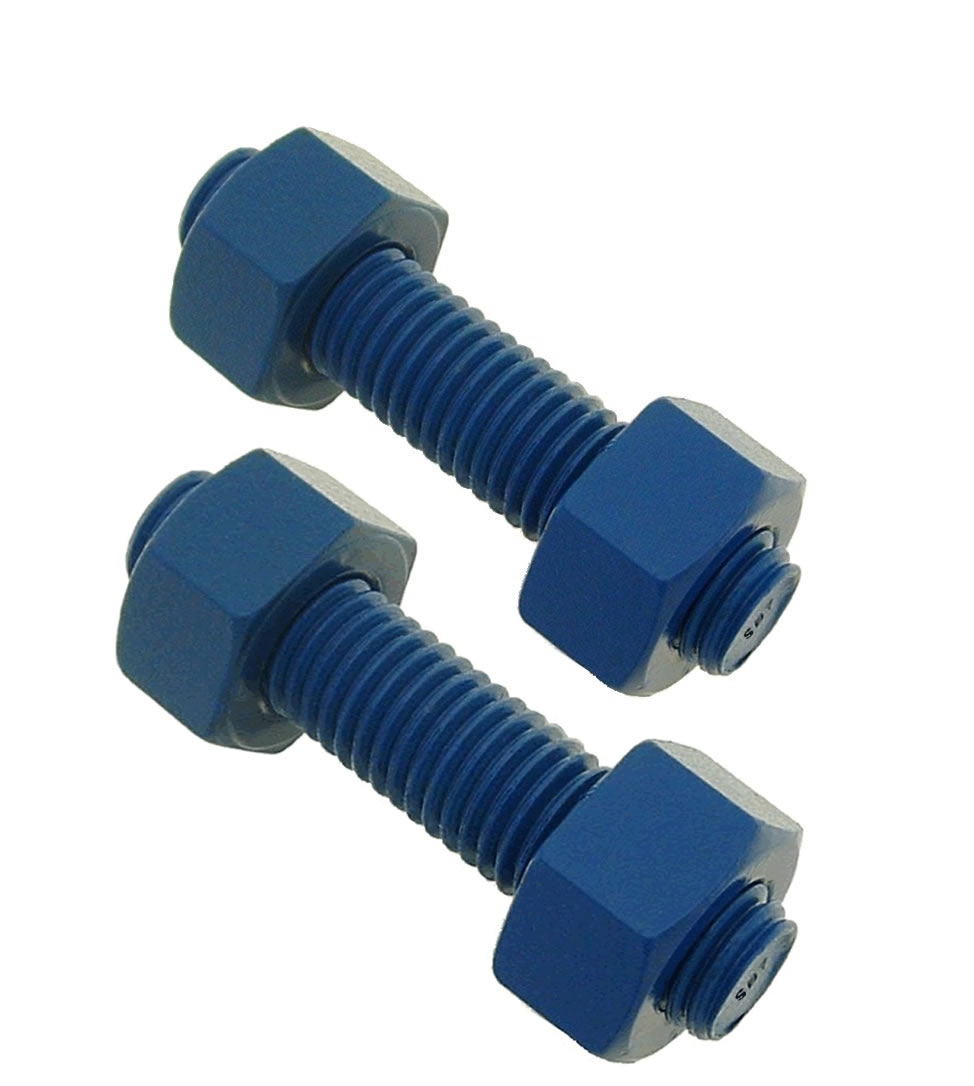
Xylan coated bolts come in many tints and the coated bolts are often coordinated with standard corporate color branding schemes. While very light shades are possible most of the popular hues range from a Dark Yellow to black with Reds and Blues and greens being the most widespread.
Moly Coated Bolts
February 6, 2010 by Sigma Fasteners · Leave a Comment
Moly Coated Bolts
Molybdenum disulfide coated bolts are commonly used to improve the performance in extremes of load carrying capacity, operating temperature and coefficient of friction. This coating provides effective lubrication in a wide range of loads, in many cases exceeding 250,000 psi. Moly coatings lubricate sacrificially by transferring lubricant between the two mating surfaces, which helps to reduce both wear and the coefficient of friction.
Moly coatings are a combination of molybdenum disulfide lubricant and high performance resins. The coating is thermally cured to bond thoroughly with the base metal of the coated part.
Moly coated bolts can solve problems associated with corrosion, chemical exposure, and abrasion. offer excellent corrosion and chemical resistance and a barrier protection better than phosphate. With Moly’s exceptional barrier protection, it is appropriate for more severe environments and is often used in chemical processing and oil field equipment.